The Unforgivable Crime of Being a Relaxed Woman
On being a “good woman”, nonsensical Puritan logic, and why a woman with no utility cannot be used — only worshipped
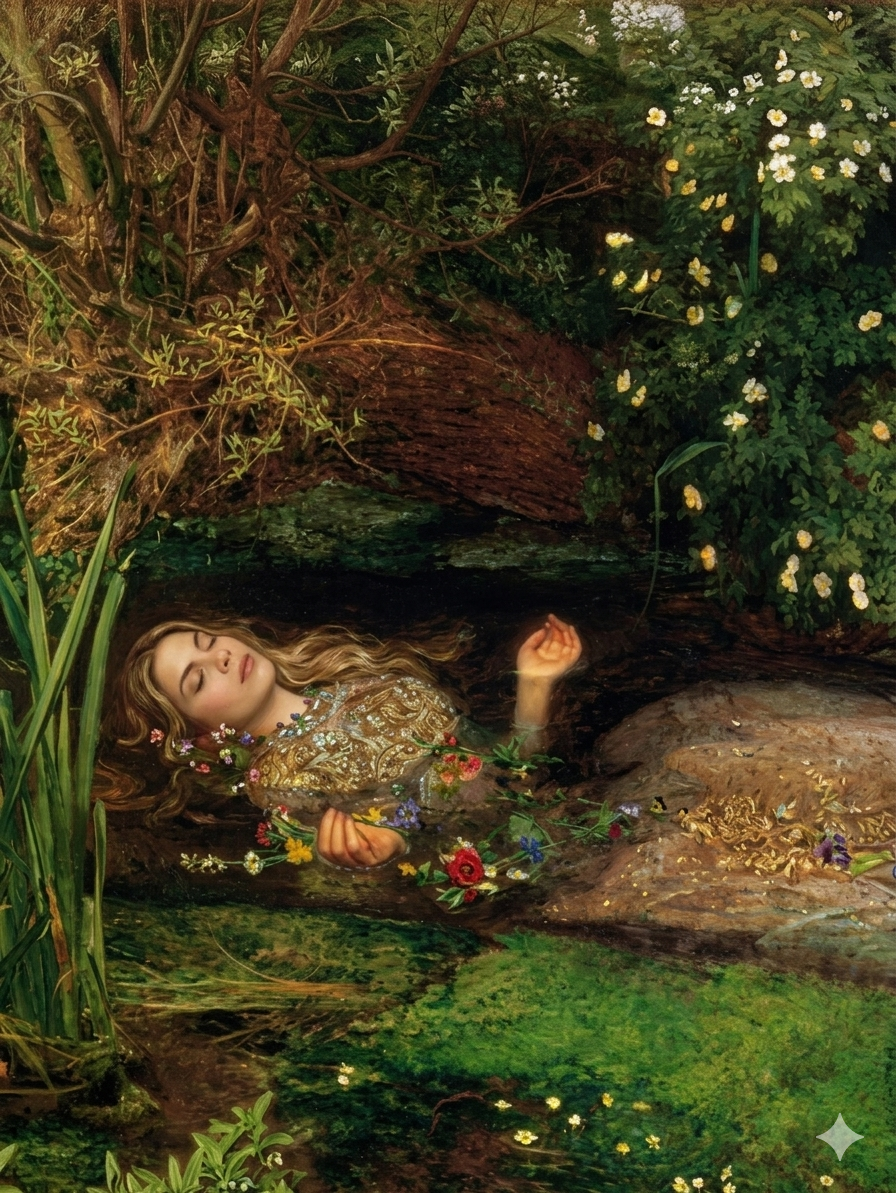
Surrounded by a group of young, dashing British polo players was a typical daily occurrence in the U.K. summer of 2026. It was the Cowdray Park Gold Cup. The biggest polo tournament in England, the kind of summer evening that makes you understand why the British tolerate the weather eleven months of the year. The light sat low and golden over the grounds. Polo players and fans alike in various states of post-match dishevelment had assembled around me with the focused energy of men who have just come off horses and require a new target.
One of them leaned in and asked a slightly uncommon question
“So what do you do in Bali?”
I captured that man with my Angelina Jolie-gaze and with a little smile replied: “I spend my time getting massages, taking surfing lessons, and sipping coconuts by the beach –just practicing being a stay-at-home wife.”
He smiled. Genuinely. “Wow,” he said, “that’s really great, tell me more.”
And in that moment I understood something I had been circling for years: when a man does not need your labor to support himself… when he is already whole, already resourced, already complete… he does not care whether you are useful.He simply wants to know if you are interesting. The men who flinch at the stay-at-home wife answer are the ones who were quietly auditing what you could do for them. The ones who light up are the ones who actually want to know who you are.
The much more insidious cousin to the question that I typically feel loath to answer is “so what do you do for work?” Notout of curiosity, I have come to understand, but out of necessity. The question is rarely about discovering who you are. It is a credit check. It is the system running an intake form before deciding whether to invest or worse, ‘what can you do for me.’
When I hear it phrased this way, I always feel inclined to ruffily respond with a Gentleman in Moscow variation, “It is not the business of ladies to have professions.”
Despite my carryover childhood sarcasm, in truth I have been both kinds of woman in life. The one who performed her productivity like a credential. And the one who stood at a polo match in England and watched a man’s face arrange itself into genuine delight at the news that she had mastered the art of doing nothing particularly useful.
This essay is about how I got from one to the other. And why the journey is harder than it has any right to be.
“The question ‘what do you do’ is rarely about curiosity. It is a credit check. It is the system running an intake form before deciding whether to invest.”
I. GOOD GIRLS AND WHAT THEY’RE GOOD FOR
“Good girls go to heaven. Bad girls go everywhere.” — Mae West, who understood the arrangement perfectly.
The ‘good woman’ is one of civilization’s most efficient inventions. She shows up to the church bake sale. She volunteers for the committee. She cooks, manages, organizes, remembers, and smiles in perpetuity while doing it because a woman who performs all of this without complaint earns the title of good, and a woman who refuses earns the word difficult.
Patriarchal systems did not create the ‘good woman’ out of admiration. They created her out of exploitation. Her goodness is the mechanism of her extraction. She is morally framed as the reward of her own labor, which means she cannot refuse the labor without forfeiting her moral standing, and she cannot demand compensation without appearing to misunderstand what goodness requires of her.
The Patriarchy approves of this ‘Pious Woman.’
The church bake sale is not incidental. It is the template. Female labor, consecrated as devotion rather than named as work, funds civic and religious institutions for centuries — invisible on the ledger, indispensable to the operation. The women baking, volunteering, organizing: their time perniciously coded as love rather than labor, which means it cannot be refused, cannot be compensated, and cannot be stopped without moral consequence.
The ‘good woman’ keeps the whole thing running. And she does it for free. And she is thanked. Occasionally.
So this is rallying call to you ‘good women…’
Be bad. Go everywhere.
II. THE PERVERSION OF THE PURITANS
Tim Kreider, writing in Lazy: A Manifesto, delivers the most clarifying sentence in the American productivity conversation: “It was the Puritans who perverted work into a virtue, evidently forgetting that God invented it as a punishment.”¹
Genesis is clear. Work arrived after the expulsion from Eden as divine punishment. Not gift, not calling, not purpose, but a sentence of the most grave degree. “By the sweat of thy brow shalt thou eat thy bread” is not aspirational language.
The Puritans, in their salvation anxiety, repackaged this punishment as virtue. Max Weber documented the mechanism in The Protestant Ethic and the Spirit of Capitalism: the Calvinist terror of damnation produced relentless productivity as proof of divine favor. Work hard enough and God might choose you. Rest, and you reveal yourself among the damned.²
This theology settled into American culture as Puritans settled into America. It was most vehemently indoctrinated into women, who already carried the full weight of domestic labor while being excluded from the paid work that earned social status.
A woman who rested was not merely lazy. She was morally deficient. A woman who took pleasure in her body, her time, her unhurried existence — she was dangerous.
Consider the alternative that existed long before the Puritans bible-thumpers arrived with their ledgers. Laozi, writing the Tao Te Ching in 6th century BCE China, built an entire philosophy around WU WEI — effortless, unforced action. The Tao does nothing, yet leaves nothing undone.
Kreider diagnosed what this theology produces in the people it captures: “Busyness serves as a kind of existential reassurance, a hedge against emptiness: obviously your life cannot possibly be silly or trivial or meaningless if you are so busy, completely booked, in demand.” We do not stay busy because we love the work. We stay busy because we are terrified of what we might find in the silence. The Puritans did not merely make rest sinful, especially for women. They made it frightening.
The highest human state was not productive striving but natural alignment — creation without anxiety, presence without performance. A civilization 2,600 years ago enshrined the relaxed woman as the wisest possible being.³
We had this framework. We chose the Puritans instead.
“It was the Puritans who perverted work into a virtue, evidently forgetting that God invented it as a punishment.” — Tim Kreider
III. THE MATH THEY WANT YOU BLIND TO
So who is the “they” that I reference above in the title. I could simply call it the patriarchal systems, your corporate boss asking you to “be a dear and get coffee for everyone,” or even paint a broad stroke saying it’s ‘men.’ But this would actually do you a disservice, for it is even your children. It can even be your fellow woman who pressures you to make sure you spend time after your shift at the hospital making sure to bake peanut-free gluten free cookies for the church. ‘THEY’ is, in fact, everyone who attempts to benefit and profit from the unpaid, ‘good-girl’ labor that is expected to arrive without boundaries and function as an endless free resource.
The ‘good woman’ breaks free of the patriarchy and removes the blindfold.
The system is not a conspiracy. It does not require a meeting. It simply requires that enough people benefit from the arrangement to defend it AND that the woman at the center of it be sufficiently trained to call her own exploitation devotion.
Now, the math.
The concept of a “true 50/50” in a household is a mathematical fiction, and the evidence has been accumulating for decades. A study of scientists at thirteen top American research universities found that female scientists perform nearly twice the domestic labor of their male counterparts, even in dual-career couples. Please tripled underline that last phrase: “even in dual-career couples.”
Penn State researchers documented the structural cause: “Professional culture has been structured to assume that the professional has a stay-at-home wife and access to vast resources of unpaid labor.” Married men with families earn more, advance faster, and live longer than their unmarried peers. For women, the data reverses.⁴
Consider the dissertation. The man writing his PhD while his partner manages the household, the children, the meals, the appointments, the invisible logistics of a life in motion — that dissertation carries her labor in every footnote. His intellectual legacy is built on a foundation that will never appear in the acknowledgments page. And here is the number that makes the arrangement undeniable: women with advanced degrees are paid less per hour than men who have only a college degree.⁵ She subsidized his credential. She earns less than him for having one of her own.
For mothers specifically: the arithmetic of true equality requires accounting for what the body already contributes. A woman who nurses an infant is not available for the dishes. A woman who carried a child to term has made a contribution to the household that no amount of dish-washing equalizes, which means that a genuinely equitable domestic arrangement would have him doing approximately 80% of household labor, to compensate for the 80% of childcare labor she performs by biological and social reality. Not even accounting for the physical debt we documented in What Are Women Actually Worth?
The 50/50 myth is the good woman system’s most elegant contemporary update. It sounds like fairness. It produces the same result as every arrangement that preceded it: more from her, accounted as equal.
In How to Make Him Chase You, I wrote a prescription for the over-functioning woman: let the world burn. List everything you do. Assign each item a priority: life-or-death critical, can slide, or doesn’t need doing at all. Then ask yourself: what is a full-body yes? And what is a cringy, hell-to-the-no?
Pulling back the reins on doing everything reveals something remarkable: 90% of what you believed was indispensable isn’t. The world doesn’t implode. It won’t even get too messy most of the time. Best of all, you’ll be less stressed. You’ll stop quietly resenting the people around you. And the man who was benefiting from your over-functioning will, somewhat counterintuitively, start moving toward you, because he can feel that you aren’t angry anymore.
“90% of what you believed was indispensable isn’t. The world doesn’t implode. Pull back to zero and see what actually needs you.”
IV. ON BECOMING A USELESS WOMAN
Farida D once said the quiet part at a full 100 decibels:
“As a woman, one of my deepest darkest desires is to be completely useless to men. You know when they say women over 30 are expired; childfree women are selfish; ugly, fat, old women are unfuckable. I dream of being that level of useless to men. Because that’s when they’ll finally leave you alone… they’ll keep reminding you that you’re useless and unfuckable — which is great, because in their minds that’s an insult but in mine it’s a compliment. I wasn’t born to be fucked and used by them.”⁶
BUT as I’ve said earlier, it is not just men who attempt to use women, so here is the broader version:
If you serve no utility, you cannot be used.
You cannot use me. So your only choice is to worship me.
The useless woman is not lazy. She is ungovernable. She has removed herself from the economy of usefulness. The system that values women instrumentally, that extends approval in exchange for productivity and withdraws it the moment the production slows. A woman who locates her worth in her existence rather than her output cannot be extorted by the threat of inadequacy. She cannot be extracted. She is, structurally, immune.
Kreider understood this from a different direction: “Idleness is not just a vacation, an indulgence, or a vice; it is as indispensable to the brain as vitamin D is to the body, and deprived of it, we suffer a mental affliction as disfiguring as rickets.”¹ The space that idleness provides is necessary for standing back from life and seeing it whole, for the wild summer lightning strikes of inspiration that no amount of productive striving can manufacture.
The relaxed woman is not failing to produce. She is producing from her deepest nature rather than from anxiety. She is not the absence of creation. She is the condition for it.
The real crime is not that she rests. The real crime is that she has made herself impossible to extract from and a system built on female labor has no category for a woman it cannot consume.
She is not a provocation. She is a refusal.
V. MALICIOUS COMPLIANCE AS A LIFESTYLE PRACTICE
Malicious compliance: a subtle, non-violent form of resistance that subverts authoritarian systems by adhering to the letter of a rule while undermining its intended spirit. The art of the technically-cooperative refusal. The most effective dismantling of a system that requires your willing participation is not confrontation, which the system is designed to absorb, but the elegant, systematic withdrawal of the thing it needs most: your exhausted, grateful, guilt-ridden productivity.
Consider: the good woman shows up to the bake sale. The maliciously compliant woman brings store-bought cookies. With the receipt showing. And a smile that dares anyone to comment.
Consider: the good woman answers “what do you do” with a full accounting of her productivity. The maliciously compliant woman says “I’m a practice stay-at-home wife” and watches the room reveal itself.
Consider: the good woman over-functions until resentment calcifies into the walls of her relationship. The maliciously compliant woman pulls back to zero. Stops giving orders, stops making requests that open negotiations, says “no” without explaining why, and sets non-negotiable free time to do whatever the hell she wants: takes herself on an adventure date, runs in the forest, does absolutely nothing.
Every small act of malicious compliance removes a brick from the structure. You are not required to tear the whole thing down today. You are required only to stop breaking your back to hold it up.
What you do matters. Not just for yourself, but for other exploited people around you. The patriarchy runs on the participation of the people it extracts from. Withdraw the participation. One refusal, one midday Tuesday massage, one unapologetic long lunch at a time… and watch what the machine reveals about itself when it no longer runs smoothly.
“The patriarchy runs on the participation of the people it extracts from. Withdraw the participation and watch what the machine reveals about itself.”
VI. YOUR PERMISSION SLIP
Bashar, the channeled teacher whose work shapes my understanding of alignment, teaches one thing above all others: you don’t have to do anything. You get to do things. The shift from obligation to permission. From performance to presence. From earning your existence to inhabiting it.
The guilt you feel when you rest is not your conscience. It is your conditioning. It is the internalized voice of every system that has ever needed your labor. Identify it. Name it. Set it down the way you set down a bag you’ve been carrying so long you forgot it wasn’t part of your body.
Nicola Jane Hobbs wrote the manifesto I keep returning to:
“I do not want to be remembered as a woman who was always exhausted. I would like to be remembered as a relaxed woman, a compassionate woman, a curious, joyful, pleasure-loving woman. A woman who works hard and rests deeply, who loves fiercely and lives peacefully. A woman who knows her worth and her power, who accepts her imperfections and her vulnerabilities. A woman who laughs and cries and aches and loves and is enchanted by the mess and magic and mundaneness of this beautiful, shimmering life.”⁷
This is not a fantasy. This is a decision.
It does not require Bali. It does not require the handsome polo players vying for your attention. It requires only the willingness to stop performing your worth and start inhabiting it.
To take the afternoon off. To eat the long meal. To answer the question of ‘what you do’ with what you actually love.
To be, for one hour, one day, one month, one year or more… completely… and gloriously… useless.
And to discover that uselessness feels exactly like sovereignty.
Good girls go to heaven.
Bad girls go everywhere.
Go everywhere.
Love always,
— Amanda
Sources & Citations
1. Kreider, Tim. “Lazy: A Manifesto.” We Learn Nothing. Free Press, 2012.
2. Weber, Max. The Protestant Ethic and the Spirit of Capitalism. 1905. Trans. Talcott Parsons. Routledge, 2001.
3. Laozi. Tao Te Ching. Trans. Stephen Mitchell. Harper Perennial, 1992. On wu wei and effortless action as the highest human state.
4. Schiebinger, L., Henderson, A.D., & Gilmartin, S.K. (2008). Dual-Career Academic Couples: What Universities Need to Know. Michelle R. Clayman Institute for Gender Research, Stanford University. See also: American Association of University Professors. (2010). Housework Is an Academic Issue. Academe, 96(1).
5. Schiebinger, L. & Gilmartin, S.K. Women in Science: The Clash of Cultures. Penn State University. On professional culture’s assumption of a stay-at-home wife and unpaid domestic labor.
6. D., Farida. Quoted from widely circulated writing, faridad.com. Exact source: original essay published online.
7. Hobbs, Nicola Jane. Quoted from widely shared writing. Original publication: nicolajanehobbs.com.