
The Snake Doesn't Owe You an Explanation

On building new friendships and letting go of people who no longer serve you.
Last week, I had a first date –a friendship date. Her name was Anne.
We matched on Bumble BFF — which, if you haven’t yet downloaded a friend-dating app to find platonic companionship in your thirties, I salute your confidence and mourn your naivety — and decided, as one does with strangers on the internet whose profile pictures suggest they won’t murder you, to meet midday under a beach umbrella in Bali.
Within forty minutes of sitting down, we discovered something that managed to be both hilarious and quietly devastating: we had lived the same story.
Different names. Different cities. Same plot.
My friend was Karina. Her friend was Sharon. Both of us had watched someone we called a best friend — someone we had laughed with, traveled with, confided in — go quiet. Not in the honest way of a difficult conversation. In the other way. The unfriendly-capser-ghosting way. The way where someone consciously ignores your text messages while performing her “awesome life” on social media, and you sit with your phone in your hand wondering what you did that was so unforgivably wrongthat it warranted a friend-death-sentence without trial.
I know that question. I sat with it at 2am. I wrestled with it in my nightmares. I reconstructed conversations, forensically, looking for the moment I must have said the thing that broke everything. I have wondered, in the specific, corrosive way that only abandonment produces: Was it me? Am I the problem? Why won’t the person I love fight for our relationship?
Anne knew these questions too. She nodded the way people nod when you’ve said the thing they’ve been carrying alone. Building a forensic chart with red string, photographs, and well-worn pinboard.
Here is what I want to give you, in the space of this essay: not the answer to why the person left. But something considerablymore useful than that.
“Was it me? Am I the problem? Why won’t the person I love fight for our relationship?”
I. Stop Chasing the Snake That Bit You
A monk once offered this parable:
Imagine being bitten by a snake, and instead of focusing on healing from the poison, you chase the snake to understand why it bit you and to prove that you didn’t deserve it. You want an apology, or an explanation, or at minimum the acknowledgment that the bite happened and that it hurt.
The snake, meanwhile, has already returned to the grass.
This is what most of us do with lost relationships, either of the friendship or romantic variety.
We chase the snake.
We reconstruct the timeline.
We catalog every conversation, every missed signal, every moment where things might have shifted.
We present our case to ourselves in the middle of the night: I was a good friend. I showed up. I chose her. I didn’t deserve this.
All of which may be entirely true.
And all of which constitutes venom still working its way through your system while you spend your energy on the wrong question.
The snake’s reasons belong to the snake. The wound belongs to you. And only one of those two things actually needs your attention.
There is a phrase that circulates the internet without a verified author — anonymous, and none the less true for it: “People don’t abandon people they love. They abandon people they were using.”
Sit with that for a moment. Not as an indictment of the person who left — but as a release from the indictment of yourself. If someone found it possible to vanish without a word, to ghost rather than communicate, to choose the cleanness of disappearing over the difficulty of honesty — the deficit lives in them, not in you. The snake bit because that is the snake’s nature. Understanding the snake changes nothing about the wound.
What changes the wound is deciding to treat it.
“The snake’s reasons belong to the snake. The wound belongs to you. Only one of those things needs your attention.”
II. Why Your Brain Won’t Let It Go (And What To Do About It)
Do not mistake your rumination for weakness.
Neuroscientists studying social pain have identified something that can reframe how you understand your 2am forensics antics: the brain processes social rejection in the same neural regions as physical pain. The anterior cingulate cortex and the anterior insula — structures that ‘light up’ when you burn your hand or twist your ankle — activate with equivalent intensity when a close friend abandons you without explanation.¹
This is not a metaphor. This is not oversensitivity. This is your nervous system doing its oldest reptilian job: identifying the source of a threat so it can protect you from the same injury in the future.
The rumination is the brain’s search algorithm, running (yes, even in your dreams). It wants to understand what happened so it can prevent it from happening again. It wants a cause. It wants a reason. It wants something it can file and close.
The problem is that when the snake offers no explanation, the algorithm keeps running. Searching. Returning to the same evidence. Proposing new theories at 3am. What you experience as obsessive replaying is actually the brain refusing to leave an open threat unresolved.²
The way to stop the algorithm is not to find the answer — because the answer, if it exists at all, lives inside someone who chose silence. The way to stop it is to override the threat response by offering the brain something it can actually close: the decision that you have enough information already.
You know that the bite hurt. You have observed the behavior. You decide that you prefer relationships that practice communication and respect. You know that you don’t need to chase the snake.
That is enough. The loop can stop.
“The rumination is the brain’s search algorithm, running. The way to stop it is not to find the answer — it is to decide you already have enough information.”
III. The Life-Death-Life Cycle
Clarissa Pinkola Estés, in Women Who Run With Wolves, offers a framework so old it predates the book by several thousand years: the life-death-life cycle of reality.
Everything living moves through this sequence. Trees. Seasons. Cells. Relationships. There is growth, then there is death, then from the nutrients of what died, new life emerges. The forest fire that looks like destruction turns out to be the event that clears the canopy and allows sunlight to reach the seeds that have been waiting on the floor for years. From the ashes, always, new trees.³

The mistake most people make — the one that turns grief into prolonged suffering — is to treat the death phase as the final chapter. To experience the dying of a friendship and conclude: this is the end of the story.
It is not the end of the story. It is the composting.
Sometimes the relationship is fodder for new growth— meant to direct you somewhere, or to show you a new idea. The self-imposed misery comes from trying to make a forever home in the dirt.
Some people, when a friendship enters its death phase — when the ease disappears, when the distance grows, when the work of maintaining it no longer feels reciprocal — choose to abandon rather than wait for rebirth. They confuse the death of what this relationship was for the death of what it could become. They leave before the ground finishes receiving what fell.
This is not a moral failing. It is simply a limited understanding of the cycle upon which this Earth operates. Not everyone has learned that death and life are not opposites. They are consecutive.
What this means for you, practically: the nutrients from every friendship that ended — everything you learned about yourself, about loyalty, about what you will and won’t accept — those nutrients go directly into the soil of who you are becoming. The new friendships that grow from that soil grow faster, root deeper, and bear fruit that the earlier ones could not.
Anne and I, sitting on a Bali beach, were that fruit blossoming.
IV. The Medieval Lie We’re All Still Living
Before we go further, a history perspective worth noting on why we believe we should have friends for life and if we don’t it’s some kind of moral failing.
The average person in medieval Europe lived and died within a 25-mile radius of their birthplace. Their friendships, their enemies, their entire social world — contained within a day’s walk. The priest who baptized you likely presided at your funeral. The children you played with in the dirt road in all probability surrounded your deathbed.⁴
Lifelong friendship, in other words, was not a romantic ideal. It was a geographic inevitability.
We inherited the expectation of permanent friendship from a 300,000 year human history where people literally could not go anywhere. And then we dragged that expectation into the 21st century where we routinely relocate across continents for higher education, reinvent ourselves with new careers every seven years, and encounter so many different versions of ourselves in so many different places that the person who was your best friend at twenty-two may simply be incompatible with the person you became at thirty-six.
This is not failure. It is mobility.
It is the new pace at which society, and consequentially our lives, is changing.
With this newfound pace, it is more important as ever to consistently review the companions with whom you travel.
An African proverb says: if you want to go fast, go alone. If you want to go far, go together.
What the proverb leaves room for is the understanding that different distances require different companions. The friend built to go far with your hometown self cannot always carry your currently-evolving self across the same terrain. The direction changes. The traveling companions need to change with it.
You are not a bad person for outgrowing a friendship. You may simply be a person who exists in a world where the only inevitability is change and adaptation.
V. Aristotle’s Three Friends
Aristotle, spending a considerable time in the Nicomachean Ethics thinking about the nature of human connection, sorted friendships into three categories.
Friendships of utility — those built on what each person offers the other practically. These dissolve when the utility ends. Friendships of pleasure — built on enjoyment, shared laughter, the delight of each other’s company. These dissolve when the pleasure fades or the circumstances change. And friendships of virtue — built on genuine admiration of the other’s character, on wanting good things for them not because of what they provide but because of who they are.⁵
Most friendships, Aristotle noted without sentimentality, fall into the first two categories. Which means most friendships are seasonal by nature. Not because the people in them are shallow — but because utility and pleasure are circumstantial, and circumstances change.
Seneca, writing his letters from Rome roughly four centuries later, drew the same conclusion from a different direction. He wrote extensively on the selection of friends — arguing that a person who befriends everyone has befriended no one, and that the quality of your inner circle constitutes the quality of your inner life.
He also addressed the grief of losing a friend with characteristic directness: mourn, he said. Mourn fully and without apology. But do not make mourning your permanent address.⁶
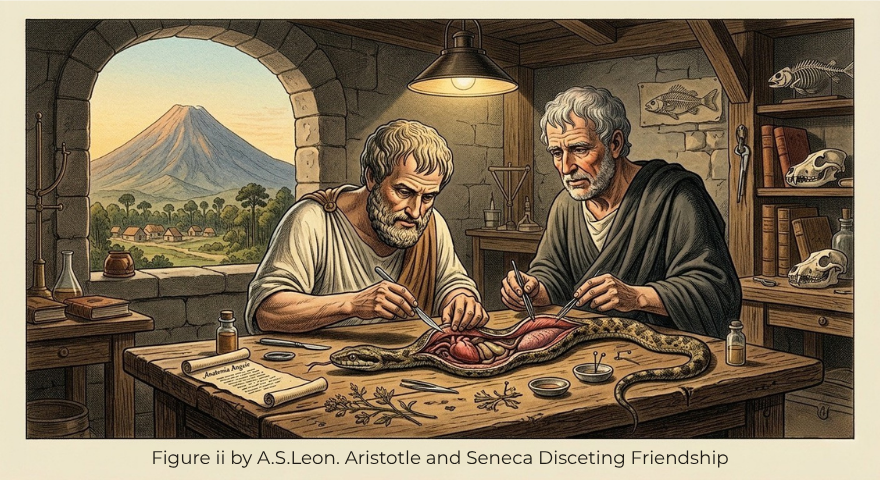
Both of these men — separated by centuries, writing in different languages about different civilizations — agreed on the same essential thing: not every lost friendship represents a failure. Some friendships complete their natural function and release. The grief is real. The ending is also right.
The question is not whether you should have kept it. The question is what you build next.
“Seneca said: mourn fully and without apology. But do not make mourning your permanent address.”
VI. Clarity of Values
I have lost multiple close friendships in my adult life. Each one felt, at the time, like losing a small part of my identity, or who I was when I was with them.
Teresa, in high school — the particular grief of watching a friendship that defined your adolescence quietly close, like a book you didn’t realize you were reading for the last time. Iris in college, which carried the specific sting of shared history dissolving just as you thought you were finally becoming yourselves. Debra, while I was on my Bali trip— a friendship I discovered, painfully, rested on a foundation that couldn’t hold the weight of someone else’s story about me. She never asked for mine. And Karina, most recently — a loss I did not see coming, from a person I had genuinely loved.
When someone you love disappears from your life, the brain registers it as a real death. That person is now dead to you and your reality even if they are somewhere out in the world living. I mourned each of them. Properly. The grief was not small and I did not pretend otherwise.
For some people, it is easier to run away or blame others, than to self-examine the thing that is actually bothering them. And that’s okay —everyone is on their own journey.
What I have come to understand is that each loss was also a course correction, a clarification, if you will. Not of who they were — but of who I was becoming, and what I needed around me to keep becoming her. Every departure sharpened something in me: what I value in a friendship, what I offer to others, what I will not accept in silence. They did not teach me these things by failing me. They taught me by leaving a space that only the right person could eventually fill.
I no longer lose sleep asking why Karina went quiet. The snake returned to the grass a long time ago.
What I carry forward instead is this: a deeper knowledge of myself, a clearer sense of what real friendship asks of a person, and the quiet certainty that I am still here — still willing to do the work, still showing up, still growing into being an even better friend to all those I love.
The lost friendships did not diminish me. They composted into exactly who I needed to become.
VII. Who Lost Who, Really?
This past January 2026, I decided to stop carrying the burden of mourning a friendship lost alone. When I told my friend Benny about Karina — when I finally laid out the whole story, the silence, the unanswered messages, the relayed social media posts that confirmed she was alive and simply choosing not to respond — Benny listened the way good friends listen: completely, without preparing her rebuttal, without rushing to the comfort.
Then she asked me something I have not stopped thinking about.
“Did you do something so unforgivably wrong it warranted this kind of treatment?”
I sat with it. Honestly. I examined the record.
No. I did not.
“Then,” Benny said, “who lost who, really?”
Three words that reorganized everything.
Because the frame I had been operating from — the one that placed me as the person who had lost something — contained an assumption worth interrogating. I had been mourning the loss of Karina. But Karina lost me.
She lost a friend who showed up in the difficult moments. Who consistently chose conversation over disappearance. Who has maintained friendships across oceans and time zones and years of genuine divergence, because she believes that the people worth keeping are worth the work of keeping them.
Benny, my number one hype-woman, gently reminded me of what my friendship was worth.
I brought this reframe to Anne, there on the beach. I watched her sit with it the way I had sat with it — turning it over, examining it from the underside.
And I watched the weight lift from her chest.
“I like that,” she said. “Who really lost who?”
Was it Anne who lost someone who ghosts at the first sign of difficulty, who ignores messages while curating a highlight reel, who cannot extend to a friendship the same basic courtesy she would demand for herself? Or was it Sharon who lost a woman who wanted to build something that could withstand the storms — and was willing to do the work?
You already know the answer.
So does Sharon, somewhere. Even if she hasn’t admitted it yet.
VIII. The Five People Who Are Quietly Becoming You
The research on this is unambiguous: you become the average of the five people you spend the most time with. Not in the vague over-regurgitated business advice sense — in the measurable, documented sense. Social contagion shapes behavior, emotional regulation, ambition, and self-perception with an efficiency that most people dramatically underestimate.⁷
This means that releasing a friendship (with proper communication) that no longer serves where you are going is not a selfish act. It is an act of graceful precision. Of knowing what terrain you are trying to cross and choosing accordingly the people you bring with you.
It is also, critically, an act of respect toward the person you release. You are not condemning them. You are acknowledging that the direction has changed, that the distance between who you are becoming and who they are suits a different kind of companionship — and that pretending otherwise serves neither of you.
Not every friendship is meant to span a lifetime. Some are meant to span a chapter. The chapter still mattered. The friendship still had value. Its ending does not revoke the meaning of its existence.
You are not a bad person for arriving at the end of a chapter. You are simply a person whose story is evolving.
IX. What Was Looking for You Couldn’t Find You Yet
Anne and I sat with our toes in sand and bellies full of fish and laughter. We had met three hours earlier. We had, in that time, told each other the kind of stories that usually require years of trust to surface. The friends who left. The nights of wondering what went wrong. The slow, difficult work of deciding that the answer to that question mattered less than the fact of our own continued becoming.
This is what the life-death-life cycle actually looks like in practice: two women on a beach in Bali, meeting with hopeful hearts for the first time, the time made possible entirely by the friendships that ended. By every person who chose to leave rather than choose the harder and more rewarding work of staying.
Those departures cleared the canopy. This conversation reached the sunlight.

Here is something I have come to believe: sometimes what we want cannot find us because we are not being fully ourselves. We are still holding on — to the old story, old friends who keep us stuck, the old version of who we were, the old grief that has become so familiar it started to feel like identity. What was looking for us could not locate us inside all of that. The moment we set it down — the moment we stopped gripping the small bear — something new can finally move in.
And someone new did move in.
I cannot tell you that Anne and I will be friends forever. That would be a promise I have no authority to make, and a framework I no longer trust anyway. The expectation of permanence is what turns the natural death of a friendship into a verdict on our worth.
What I can tell you is that she is a strong brick in the building of who I am becoming. That the conversation we had mattered. That whatever this friendship grows into — whether it spans a season or a decade — it carries the nutrients of every friendship that ended before it.
We kept moving forward, believing that we deserved friendship. The universe rewarded the courage by introducing us to another human to share our life experience.
The snake is long gone living its life somewhere in the grass.
The wound is healing, one relatable conversation at a time.
From the ashes, look — something new and green is already sprouting.
With Love Always,
— Amanda
Sources & Citations
1. Eisenberger, N.I., Lieberman, M.D., & Williams, K.D. (2003). Does rejection hurt? An fMRI study of social exclusion. Science, 302(5643), 290–292.
2. Kross, E., Berman, M.G., Mischel, W., Smith, E.E., & Wager, T.D. (2011). Social rejection shares somatosensory representations with physical pain. Proceedings of the National Academy of Sciences, 108(15), 6270–6275.
3. Estés, Clarissa Pinkola. Women Who Run With Wolves: Myths and Stories of the Wild Woman Archetype. Ballantine Books, 1992.
4. Hanawalt, Barbara A. The Ties That Bound: Peasant Families in Medieval England. Oxford University Press, 1986. On geographic immobility and social radius of medieval European communities.
5. Aristotle. Nicomachean Ethics. Trans. Terence Irwin. Hackett Publishing, 1999. Books VIII–IX on the three types of friendship.
6. Seneca. Letters on Ethics (Epistulae Morales ad Lucilium). Trans. Margaret Graver and A.A. Long. University of Chicago Press, 2015. Letters III, VI, and IX on the selection and loss of friends.
7. Christakis, N.A., & Fowler, J.H. (2009). Connected: The Surprising Power of Our Social Networks and How They Shape Our Lives. Little, Brown and Company. On social contagion and the measurable influence of close social circles.
