Be a Lazy Man's Worst Nightmare
No, Seriously, Be Menace to Men, They Like It.
A woman with standards is not difficult. She is clarifying. She doesn't lobby, argue, or convince. She simply holds a line — and watches who rises to meet it.
I. I AM NOT YOUR PEACE
There is a trend circulating the internet with enough velocity to have accumulated hundreds of millions of views, in which men announce — with the sincerity of someone who has never once considered doing his own interior work — that what they want in a woman is someone to "be their peace." She ‘should’ be calm. Soft. A landing pad for whatever chaos he has generated in the rest of his life and a cooling-balm of avoidance to his own accountability.
Let’s address this idea of peace directly.
On June 11, 1963, a 67-year-old Vietnamese Buddhist monk named Thích Quảng Đức arrived at a busy intersection in Saigon.1 He sat down in the lotus position in the middle of the street. Two younger monks poured aviation fuel over his head. He reached into his robes, removed a matchbook, struck a match, and dropped it into his lap.
He did not move.
Flames consumed his robes and his flesh. The street was loud — monks chanting, onlookers wailing, sirens trying to break through the cordon of praying bodies. He chanted softly. His eyes stayed closed. As his body began to collapse, he reached an arm out, braced himself, and kept chanting. Neuroscientists have since studied how decades of advanced meditation physically restructured his brain — specifically the anterior cingulate cortex and insular cortex² — enabling him to remain centered inside fire that would reduce any ordinary nervous system to pure animal panic.
President Kennedy, when shown the photograph, said: "No news picture in history has generated so much emotion around the world as that one."
That is peace. Not the absence of chaos. The capacity to remain centered inside it.
No one can give you peace. Peace is something you inhabit and can only be tested within chaos.
A man who needs a woman to “be his peace” does not have peace. He wants a woman willing to do the spiritual labor he’s failed to do for himself. You cannot outsource an interior condition. Thích Quảng Đức did not need the intersection to be quiet. He did not need the crowd to stop crying. He brought the quiet with him. It lived in the restructured architecture of a mind that had spent decades building peace.
Peace is an inside job. Always has been. No person on earth has the capacity to hand it to you — and if you need other people around you to be peaceful in order to maintain your ‘inner peace,’ you don’t actually have peace at all. You have a shell of nothing.
I will be your fire. Your desire. Your reason to get out of bed and do something worthy of the life you were given. I will hand you purpose with both hands and take genuine delight in watching you rise to meet it. But I will never give you peace. That is yours to find — and mine to keep.
Instead, I intend to be an absolute menace to your life that will enable you to cultivate true inner peace and patience.
My mother always told me growing up “the meaner you are to men, the more they want you.” I’m sure she’s reading this now and cackling to herself, thinking “yeah, I said what I said.”
By “mean,” she did not mean cruel. She meant unbothered and boundaried, which people who want to take advantage of you label as “mean.” Both of my parents wanted me to be a woman so committed to pleasing herself that a man's approval becomes optional (and usually irrelevant) information rather than required oxygen. Men who are worth anything — not boys, men — are moths to that flame of confidence. Absolutely infatuated. The woman who is already full does not need to be fed with approval, and that self-respect reads, to any man paying attention, as the most magnetic quality in the room.
And what do the men who love it say? “that is the problem. if she wanted to dance i would let her wreck the furniture. if she wanted to cook i would let her burn down the house. and if she wanted to scream i would let her deafen me. I've never loved anyone enough to let them destroy me but God, she could take me by the throat and my eyes would sparkle at the mere inches between us.”-- Her by R.R.
II. THE DEATH OF THE COOL GIRL (MAY SHE REST IN PEACE)
It was a 11:34pm at nightclub in downtown Houston, TX. He was drunk. A random girl was dancing on a platformed speaker — hands, hips, the whole performance — and he was grinding against her with the unselfconscious abandon of a man who’d decided, somewhere in his second drink, that I, his girlfriend, would be totally cool about this.
As I soberly drove us home, my boyfriend Doug would turn to me and say:
"You're so chill."
Above gritted teeth, I smiled. It wasn’t the first time, nor the last that I witnessed this behavior and both said and did absolutely nothing. I was supposed to be secure, unbothered, nonchalant, fine… right?
It wasn’t the first, nor the last instance of this behavior.
If I could’ve been the uncool girl, the bothered girl, the boundaried girl, perhaps a communication and hard talk could’ve saved me 2 years of my life. But alas, the best lessons are often learned the hard way.
In the long run, I dodged something — a bullet, specifically. The bullet being a version of my life in which I spent the next decade imagining what new inappropriate touching he’d invent on friend trips regardless of whether I was there to witness or not.
The Cool Girl does not save herself from grief and disappointment. She just delays the reckoning until it is more expensive.
Gillian Flynn named her in Gone Girl3 — the woman who eats hot dogs and loves football and never gets angry about anything and thinks it's hilarious when you behave badly — and she named her so precisely that half the women reading it recognized themselves mid-paragraph and had to put the book down. The Cool Girl is not a personality. She is a strategy. Specifically, the strategy of making yourself frictionless enough that no one ever has to confront the question of whether they deserve you.
The data, as it turns out, agrees. Stanford researcher Angelica Puzio Ferrara coined the term "mankeeping"4 in a 2024 paper at the Clayman Institute for Gender Research — the invisible, unreciprocated emotional labor women perform to manage men's moods, stress, social lives, and inner worlds. About one in five men in the United States5 reports having no close friends. Which means that for a significant number of straight women, being "easygoing" and "chill" is not a personality quirk. It is an unpaid position as someone's entire emotional infrastructure. His bro. His therapist. His social secretary. His sounding board, his cheerleader, his reason to believe he is a good person despite mounting evidence to the contrary. All filed, very tidily, under support.
The Cool Girl performs this labor and calls herself chill while doing it.
I am no longer nonchalant.
I CHALANT.
The upgrade is not complicated. State what you want. Name what is not working. Say it early, while the cost of leaving is still low, rather than three years in when the cost of staying has already been paid. Boundaries and communication are not the opposite of ease. They are the foundation of it. The woman who accepts everything, asks for nothing, and calls herself ‘low-maintenance” is not easy to love. She is easy to take for granted. There is a difference, and it costs her everything.
So be high-maintenance. Be a menace.
III. MANAGING MEN UP
There is a term in the corporate world for what you do when your boss is not managing you effectively: you manage up. You understand their blind spots. You create the conditions in which the work gets done, the standard gets met, and the best version of the collaboration becomes possible — not by pretending the gap does not exist, but by bridging it with deliberate, strategic grace.
I practice this with all men, but my stepdad is the most regular victim to my quiet demands.
He is, I should say, genuinely wonderful. Loyal, hardworking, devoted to his family in the particular way of men who find their purpose in what they can provide and build. He works for us, and for love, and because contribution is how he earns his own esteem — which I say not to diminish him but because I understand it completely. And because understanding it is precisely how I can tell him, with complete affection and zero apology: "You're welcome for giving you purpose. Imagine, you’d still be in the streets with your slutty ways with more baby-mommas if you hadn’t found us. Now you have the best daughter ever and a big, incredible family who adores you. We love you papa."
He laughs. Then he does the thing I needed him to do.
This is not manipulation. Manipulation requires concealment. What I am describing is something more straightforward: I see him clearly, I know what he is capable of, and I hold that standard visible so he has something to rise to. The men in your life — fathers, bosses, partners, coaches — do not need you to accept whatever they offer. They need you to know the difference between what they are giving and what they are capable of giving, and to make that gap gently, warmly, undeniably apparent.
There is a distinction worth naming: the difference between running a man and raising the standard for one. Running him is exhausting. Raising the standard is generous. It treats him as capable of more — which, incidentally, he usually is.
You hold the line. You make clear, through behavior more than words, what you expect — and then you step back and let him decide whether he will meet it. The men who cannot are not your project. They are your information. And they delivered it cheaply, which is the one useful thing they will do for you. (Tattoo this to your forehead.)
This works in every direction. Boardroom, dinner table, polo field, family dinner. The woman who knows what she is worth and holds it quietly is not difficult. She is in fact generous and loving because she knows that this man is not only capable of more, but he wants more and he’s been subconsciously waiting for someone to give him the opportunity to be the hero he so desires to be.
IV. AMANDA’S FIELD GUIDE TO BEING A MENACE (MAN-APPROVED)
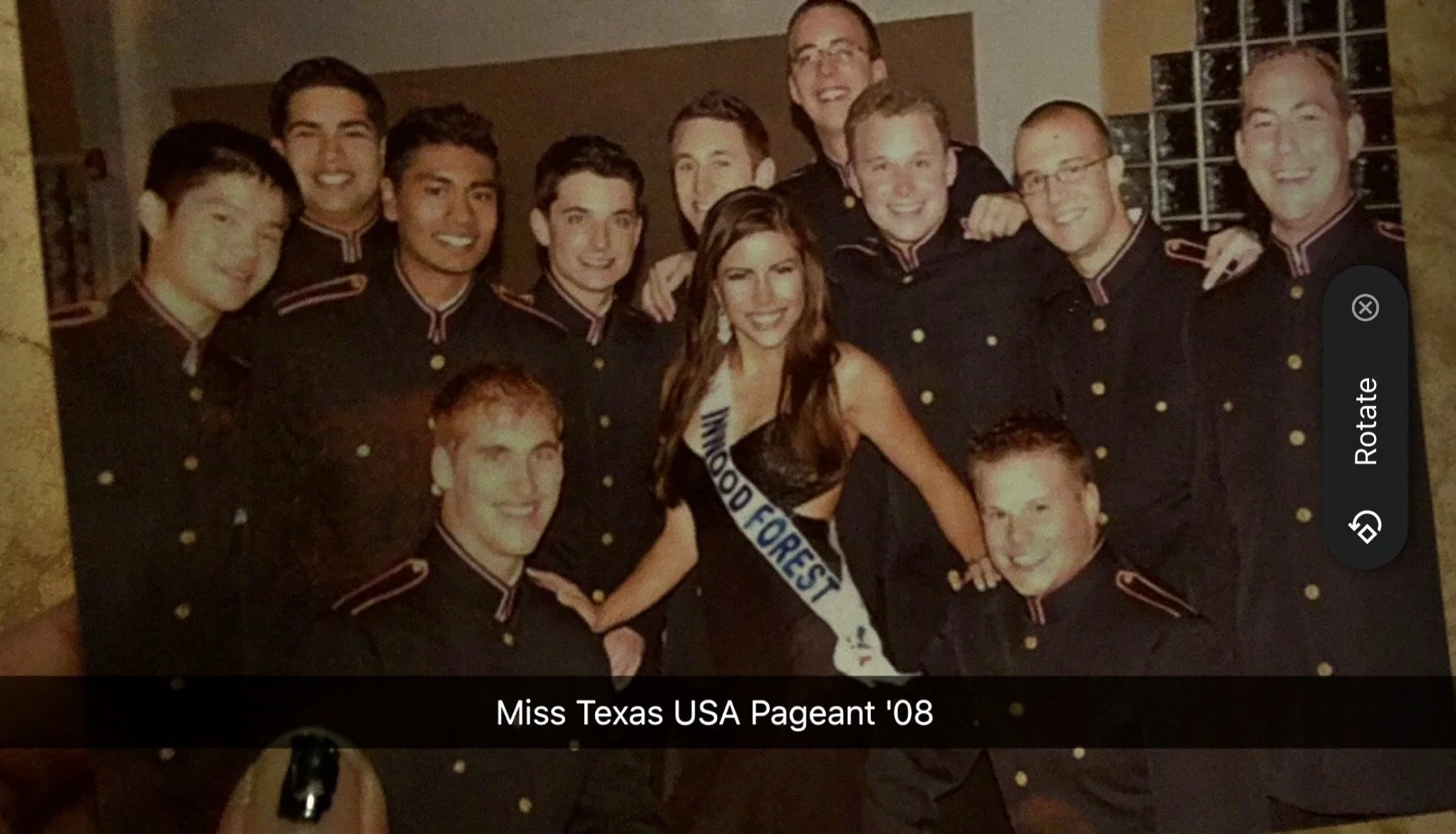
Look at the grins on these men’s faces. You can’t tell me that men don’t love women and aren’t happy to bend the knee.
Here is the thing about standards that nobody tells you, perhaps because it ruins the argument that having them is hard: you do not have to say a single word.
You do not lobby. You do not plead. You do not reprimand. You do not send the long text. You do not sit a man down and overexplain, in measured tones, why you deserve to be treated well and what that looks like in practice. People do not learn through speeches. They learn through observation. The way you carry yourself in a room — the ease of it, the quality of your attention, the silent signal of a woman who is already enough and knows it — communicates more in thirty seconds than an argument could manage in thirty minutes.
The staff and male acquaintances at my co-working space in Bali lovingly call me “Princess” every morning that I walk inside the building. I did not ask them to. It arrived without negotiation, simply from the way I move through the space — floating on air, a smile for everyone, a graceful hello, the unhurried quality of someone who has decided that the room is fortunate to have her in it. The title appeared because the energy preceded it. You cannot demand that reception. You can only become the kind of person for whom it arrives naturally.
And then there is the birthday dinner.
Every year, I hold a dinner to celebrate myself, which I do without embarrassment and recommend without reservation. It was the year before last that my friend sent a message saying she was devastated to miss what she called the men's yearly pilgrimage to pay homage to their goddess Amanda. She meant it as a joke and also entirely literally.
What happens at my birthday dinner is this: the men arrive with flowers. Giant bouquets, most of them. Gift certificates for massages. Several dressed up, which in Bali — where the dress code is flip-flops and spiritual ambiguity — is a significant commitment. None of them had been asked. Not a single one. They arrived this way because their time in my energy had communicated, without a syllable of instruction, that this was how one showed up for me. And they were happy to do it. Not obligated. Not performing. Happy — the way people are happy to contribute to something that they can feel, in their bones, is worth contributing to.
I accepted every kind, thoughtful gift with genuine grace and zero guilt.
I think about the woman who might look across the room at that scene and say, "I don't even like flowers." She might even believe that she means it. But, I would argue, she might also be protecting herself from the disappointment of never getting, the admission that she’s never been in a room where someone thought to bring them. Those are two different sentences, and only one of them is honest. The woman who cannot receive has, somewhere along the way, decided she is not worth the effort. She is wrong. Completely and utterly wrong. And the only reason I know this is because I was briefly, in a past life, also wrong about it.
A former partner once told me something I have carried since: "Sometimes I feel so frustrated because you hold me to a higher standard. But at the same time, it excites me. I feel excited to rise. To be a better man."
That is the confession men rarely make and nearly all of them mean. The ones who want to walk all over a woman are either insecure sociopaths — or they are bored, secretly wishing she would push back. A woman with standards is not an obstacle. She is the most interesting challenge available. She is the reason to try.
There is one more thing worth naming — the evolutionary footnote that explains why a boundaried woman is not just incredibly attractive but, at the level of the male nervous system, trustworthy in a way that goes far deeper than conscious preference. A woman who holds her standards with the man she loves will hold them everywhere. That signal — that she is not infinitely available, not infinitely accommodating, not managed by whoever applies enough pressure — tells a man something his nervous system has been trying to assess since before language existed: she will hold the line when I am not watching.
Men are, research confirms, hyperfocused on loyalty to the point of obsession — and not arbitrarily. Evolutionary psychologist David Buss, in a study across 37 cultures evaluating 67 different qualities in a long-term mate, found that men ranked "faithful" and "sexually loyal" as their top two qualities by a significant margin.⁷ The reason is not complicated: unlike a woman, who carries the child and therefore knows the child is hers, a man has historically had no biological guarantee. The only signal available to him is behavioral. A woman who says “no,” who holds her line, who is not endlessly moldable — she is, in the oldest part of the male brain, a woman who can be trusted. Which is, it turns out, the most attractive thing she can possibly be.
So. The field guide to being a Difficult Bombshell:
Hold the standard before you speak it. Your behavior is the announcement. Every time you accept less than you know you deserve, you teach everyone in the room what you believe you are worth. Every time you hold the line, you recalibrate the room — silently, effectively, without a single confrontation. It does not require a speech. It requires consistency.
Receive well. Receiving graciously is a practice, not a given. The woman who deflects every compliment, who says "oh you didn't have to" when handed flowers, who makes the giver feel faintly embarrassed for their generosity — she is returning the gift with an unsigned note that reads: I do not believe I deserve this. Receive the flowers. Receive the held door. Receive the upgrade. Say thank you and mean it. Feminine receiving is not passivity. It is the active acknowledgment that you are worth giving to.
Let the silence do the work. When someone falls below your standard, a raised eyebrow communicates more than a paragraph. The pause after a disappointing action. The quiet that follows a decision you did not like. Patriarchy trains women to fill silence with explanations, apologies, and reassurances. Stop. Let it breathe. Let him sit in the gap between what he offered and what the moment called for. He knows. They always know. Men are not stupid and treating them so is a degrading insult to their intelligence.
Disappoint people without apology. “No.” is a full sentence. The “no” is the standard in action. Every time you hold it, you reinforce the signal. Every time you cave — soften it into a maybe, turn it into a silence that gets misread as consent — you renegotiate yourself downward. The women who believe they cannot afford to say “no” are the ones who end up paying for everything. The “no” costs nothing. The “yes” you didn't mean costs years, perhaps even your life.
The woman across the restaurant, watching her birthday dinner unfold, accepting the giant bouquets, surrounded by doting dressed-up men in their button-down finery — she is not your competition. She is you, three years after you decide you are worth the effort. Tell her she can have it. Then show her how.

Spoils of war… or the results and rewards of being a “difficult” woman… idk, seems to me like they love me!
SIGNED, A DIFFICULT WOMAN (WHICH IS, NOT THAT I CARE IN THE LEAST, WHAT MEN ACTUALLY WANT)
The paradox, delivered without softening: the qualities that get a woman called difficult — opinions, standards, the ability to say no and sleep through the night — are the exact qualities men describe when they talk about the woman they cannot stop thinking about. The one who got away. The one they tell their friends about years later with a combination of frustration and reverence that has never fully resolved. Easy is forgettable. Frictionless is forgettable. The woman who holds her line, who costs something to be with, who will not be managed down or talked out of what she knows she deserves — she is the story.
Again, I remember what Mrs. Hungerford drilled into us at all-girls prep school, “well-behaved women seldom make history…” so misbehave, be difficult.
So be the main character of your story, of your life. You are not the peace. You are not the therapist, the social secretary, the emotional infrastructure, or the apology.
You are the standard.
Set it high. Hold it without explanation. Watch who rises. Forget who falls.
Signed — a difficult woman, which is, not that I care in the slightest, exactly what they actually want.
-Amanda
P.s. As I wrote this from a coffee shop in Bali, a man was peering over my should and couldn’t agree more with the idea that men prefer and respect boundaried women.
With Love Always,
Amanda
P.s. As I wrote this from a coffee shop in Bali, a man was peering over my should and couldn’t agree more with the idea that men prefer and respect boundaried women.
P.s.s. I literally just went on a date two days ago with a man who showed up to a first date with flowers, and asked “from where do I have the honor of picking you up” and proceeded to take me on a gorgeous date he planned. This is a REGULAR occurrence after you shift your energy.
CITATIONS & NOTES
1. Thích Quảng Đức — Vietnamese Buddhist monk who self-immolated on June 11, 1963 in Saigon to protest the persecution of Buddhists by the South Vietnamese Diem regime. Photograph by Malcolm Browne, AP. President Kennedy's quote confirmed by TIME. time.com/3791176/malcolm-browne-the-story-behind-the-burning-monk/
2. Neuroscience of advanced meditation and pain tolerance: anterior cingulate cortex and insular cortex structural changes in expert meditators. Manno, C. (2019). "Monk on fire: The meditative mind of a burning monk." Cogent Psychology, 6(1). tandfonline.com/doi/full/10.1080/23311908.2019.1678556
3. Gillian Flynn, Gone Girl (Crown Publishers, 2012). The "Cool Girl" monologue appears in Part Two. Flynn's essay on the character: "There are no 'Cool Girls.' They don't exist. I made her up." goodreads.com/book/show/19288043-gone-girl
4. Ferrara, A.P. & Vergara, D.P. (2024). "Theorizing Mankeeping: The Male Friendship Recession and Women's Associated Labor as a Structural Component of Gender Inequality." Clayman Institute for Gender Research, Stanford University. researchgate.net/publication/385006823
5. Male friendship recession data: Survey Center for American Life (2021) and Gallup (1990). In 2021, 15% of men reported having no close friends, up from 3% in 1990. The figure of "about one in five" reflects broader estimates across multiple surveys. americansurveycenter.org/research/the-state-of-american-friendship-change-challenges-and-loss/
6. Joan Didion, "On Self-Respect." First published in Vogue, 1961. Reprinted in Slouching Towards Bethlehem (Farrar, Straus and Giroux, 1968). en.wikipedia.org/wiki/Slouching_Towards_Bethlehem
7. Buss, D.M. & Schmitt, D.P. (1993). Sexual strategies theory: an evolutionary perspective on human mating. Psychological Review, 100, 204–232. Replicated across 37 cultures in Buss, D.M. (1989). Sex differences in human mate preferences. Behavioral and Brain Sciences, 12, 1–49.