Pickup Artists Are Closer to Greatness Than You Are
I spent my twenties as the only woman in rooms full of men learning to read women. Here is what I learned about the ladder rung men are standing on and cannot see.
The sheer black stockings shimmered on my crossed legs, as I sat in the lobby of the Beverly Hills Sofitel, waiting on a notoriously late French friend so we could eat something overpriced and beautiful upstairs, when a man sat down beside me and ran game on me.
To be fair, he was good. He paced it patiently. He calibrated every question. He worked the little push and pull of warmth and distance straight out of the textbook, and I mean that literally, because I'd read that textbook. All of them, to be specific.
At that point in my life I ranked among the most well-read people alive in neuro-linguistic programming, with a degree in cognitive neuroscience and a specialization in the exact machinery he ran on me in real time.
Watching him work felt like watching a Hollywood Boulevard street magician turn a card trick you happen to know, and know well. You can admire the hands, the patter, the misdirection of the eyes, the little flourish before the reveal, and still see the palmed card the entire time, tucked against the heel of his thumb where it has been since before he said hello.
The longer we spoke, the more something itched at him. His intuition clocked that the situation refused to behave the way his training promised. He stopped. He tilted his head. His eyes met mine and he asked.
"Wait. Are you one of the teachers at the conference?"
I was not. But the man whose conference he crossed multiple time zones to attend, the man he came to learn from, had built his field techniques on the same body of research I had spent years living inside. By pure serendipity, he tried his card trick on a magician who knew more NLP than his teacher.
But watch what he did the moment he sensed he was talking to someone who could genuinely see him. His first instinct was not shame. It was not defensiveness. It was hope.
I have turned that question over in my mind for years, and not for the coincidence. For the desire, the hunger in it.
He did not ask because he thought I'd caught him, red handed, running game. He asked because some part of him wanted to know more, know something real, and sitting there he had just felt the gap between the thing he practiced and the thing he actually came for.
It is a specific feeling, that gap, and every man who has ever run a routine on a woman and watched it work knows it: the hollow little victory of a door opening onto an empty room. He had won the exchange and lost the point. The difference, perhaps, between holding a woman's attention and connecting with her.
Here is what I could not have told him that night, because it took me years inside those pickup-artist companies to see it myself.
He was not failing at his lessons. He was excelling at them. He worked the material, flew all that way, spent real money, and learned to sit beside a woman without frightening or annoying her. By every standard that world knew how to measure, he had arrived.
He reached the very top of the only ladder anyone ever bothered to show him.
He also stood nowhere near the man he could have become. Not for lack of appetite. Because nobody in that building, in any of those three companies, across all those years, ever mentioned that a ladder continued above the place they taught him to stand.
They handed him the top of their curriculum and called it the summit. He had no way to know he stood three rungs off the ground, and that above him waited a version of himself who belonged among the best men alive.
That is the part that still gets me. In all my years consulting for that world, I never once watched it produce a great man. It was not built to. It was built to stop at harmless.
To potentially judgemental women ready to burn me at the stake for teaching men how to pick up women, put your pitchforks away for a minute because I have something to tell you directly: This man, like the overwhelming majority of men who learn pickup, is not a predator.
Remember this, because it is the whole essay. Someone handed him a system for being the cool guy who gets the girl, and neither he nor most men reading this realize how much greater they could become.
And before you settle too comfortably into your chair, let me tell you where this goes. That man in the lobby, the one you have already decided you share nothing with? He probably stands closer to greatness than you do.
Stay with me and I will show you why.
I. THE ONLY WOMAN IN THE ROOM
That lobby was the prologue. A few nights later I sat on a stage with hundreds of male eyeballs sticking to my every movement.
Picture the room. A hotel ballroom wearing the particular carpet hotels reserve for conventions, that busy jewel-toned pattern that hides everything anyone has ever spilled on it. Rows of stacking chairs. Overhead light doing no one in the room any favors. And in every seat, a few hundred men with notebooks. Actual paper notebooks, pens moving, the way men take notes when the subject is something they are ashamed of not already knowing. They had crossed oceans to learn a thing their fathers should have told them. And every one of them turned toward that stage with the specific, undefended face of a man who has decided to hope in public.
The conference belonged to Neil Strauss, the man who wrote The Game, the book that took the underground world of pickup artists and detonated it into the mainstream. I sat there with him, one woman in a ballroom of a few hundred men, demonstrating to that sea of hopeful faces how a person might approach, read, and talk to a woman without setting her on edge.
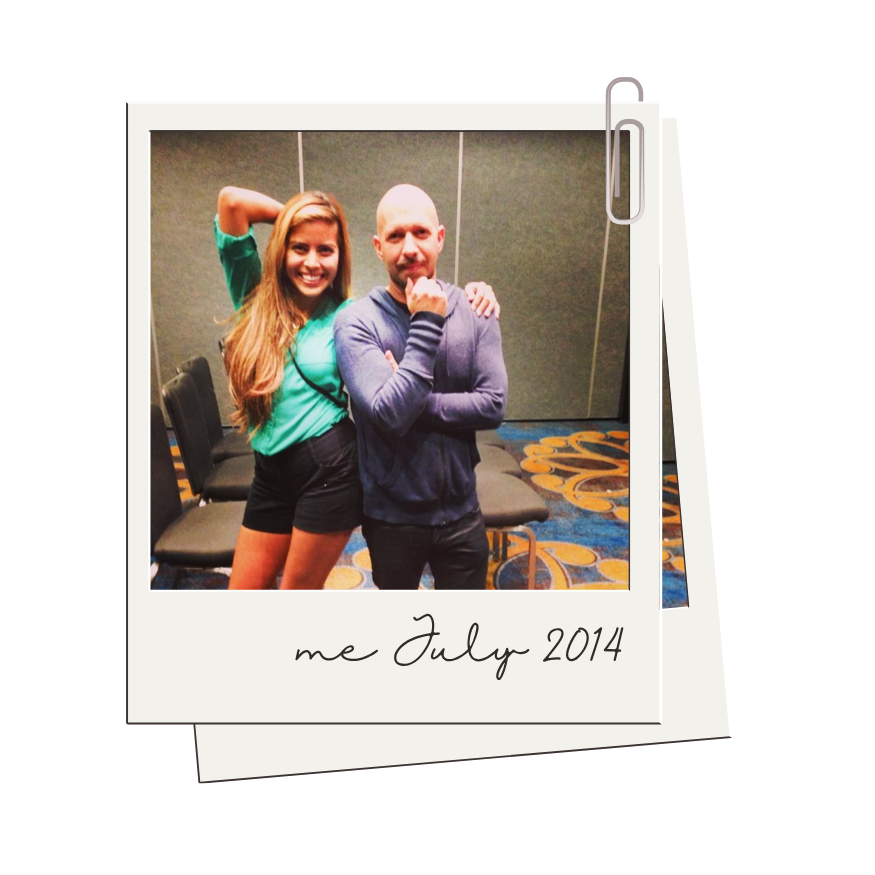
He had me rest my hands on top of his, palms open and turned up toward the ceiling. Then he lowered them. Slowly, a few inches. And he put a question to that entire room without saying a word of it aloud: would my hands follow his down, or float where they were?
The room fell silent as a few hundred men ceased breathing at once.
Mine followed.
Which meant, in a language older and more honest than speech, that I already trusted him. That I felt safe. A few hundred men leaned forward, because this was the good stuff, the thing they flew in to learn. And my inner writer fangirl screamed somewhere behind my composed face, because I sat on a stage with my hands resting in the warm open palms of ten-time New York Times bestselling author Neil Strauss, who as it turns out was surprisingly short and very bald.
This was no one-time curiosity. It was most of my twenties following this incident in July of 2014. Through a chain of coincidences so improbable I have stopped explaining them at parties, I consulted for three of the largest pickup-artist companies in Hollywood.
I worked as a paid plant in bars. You know the bars. Hollywood at eleven on a Thursday, the light the color of a bruise, bass you feel in your sternum before you hear it, a hundred conversations all pitched slightly too loud, and somewhere in the middle of it a pretty girl on a stool with a drink she is not really drinking.
That was me. Men who did not know I worked for the company practiced their freshly minted material on me, one after another, all night, and I sat there and let them, and I felt every approach land or slide off the way a doctor feels a pulse. Then I went home and wrote it up: what worked, what made a woman's shoulders climb toward her ears, what made her want to leave.
For another pickup company I went through nine rounds of interviews for a director of development role, and they rejected me because I was too attractive and would distract the men in the office. Yes, even in my Hillary Clinton pantsuit. Way too hot.
I spent my twenties as a spy behind the lines of male desire.
And recounting my story years later, some women refused to hide their disgust. "I cannot believe you are helping men trick women into bed. That is repulsive."
Here is what they miss, and everything in this essay rests on it, so I will put it in bold.
Women are safer when men can read us.
The overwhelming majority of men are not predators. They are misreaders. Think of a man who lands in a country whose alphabet he cannot read. The signs hang everywhere, on every wall, in every window, and he walks straight past all of them, not from malice but because to him they are only shapes. That is most men in a room full of women. The signs are up. He simply never learned the letters.
Nobody taught them the language. Their fathers did not teach them, their friends fed them nonsense, and the media handed them a script from people who understood women about as well as they understood particle physics.
So these men walk into rooms genuinely unable to see the signals every woman there broadcasts and receives as clearly as speech. They cannot tell a ‘yes’ from a politeness. They miss the ‘no’ forming three steps before her mouth makes the word. And they push past a line they honestly, cross-their-heart, never saw.
I taught my own version of that test in clubs, to men who needed something they could use at eleven at night with the music going and no time to think. Take her hand to lead her to the bar and buy her a drink. Then, in the middle of the crowd, let go. Open your fingers and keep walking.
If her hand stays in yours, hand clasped around yours, she wants to go where you are taking her.
If it slips away, she does not. Now you know. You know it in under a second, and she never had to find the words or the nerve to tell you.
What a man does with that answer measures him entirely. He can call it a night and talk to someone else. Or he can return to the beginning, rebuild the comfort patiently, and see whether she arrives there with him. Both honor her. Both show a man asking a question and respecting the answer he got instead of the one he wanted.
Teaching a man to see that line does not sharpen a weapon. It disarms an accident already in motion. A man at that Strauss conference came up to me afterward, glowing, saying "thank you, this is really helping me." He was no wolf I helped hunt. He was a lost man I made slightly less dangerous by making him slightly less blind.
II. THE CEILING
Now I have to tell you what took me years to see, and what I could not have seen from anywhere except inside those rooms.
Everything I just described is genuinely good. Every one of those tests makes women safer. A man who feels the precise moment a woman's hand goes slack in his own will stop, and a man who stops outranks ten men who never learned to notice.
But look where every one of those tests points.
Inward. At his own hands. Is she comfortable with me. Is she safe with me. Do I frighten her. The entire curriculum, across three companies and years of my life and thousands of dollars a head, taught exactly one question: how do I stop being the problem.
Nobody taught the other test.
In all those years, in all those rooms, I never heard one man teach another what to do when he sees a woman's hand go slack in someone else's. Not once.
Never how to confront a friend who blatantly pushed past a boundary. Never how to stand up for a woman when nothing in it served him, when she was not his girlfriend or his sister or his daughter or a woman he privately decided deserved his protection. The syllabus ended at do not be the problem. It never reached interrupt the problem.
So the finest, most diligent, most expensive product that entire world could produce was a man in the middle. That was the ceiling. A ballroom full of men who worked genuinely hard and dumped a significant portion of their checking accounts to become, at their absolute best, unremarkable.
I want you to feel what a ceiling like that does to a man, because it is subtler than a wall. A wall you can see. You walk up to it, you put your hand flat against it, you know to turn around. A ceiling you discover only by reaching.
He climbs the three rungs they gave him, he reaches up for the fourth the way a foot reaches for the next stair in the dark, and his hand closes on nothing. Not a barrier. An absence. And because nobody told him someone had cut the ladder, he concludes the only thing a reasonable man could conclude: that he has arrived, and that the emptiness above him is simply the sky.
They taught him to feel the exact moment a woman's hand goes slack in his own. Nobody taught him what to do when he sees her hand go slack in another man's.
None of that is his fault. Nobody showed him that the ladder keeps going.
What is this entire essay and good-man article series really about?
A good man is not a man who avoids doing harm. That is the floor. That is the price of admission to decent society, not an achievement anyone should congratulate. A good man wants to become a great one, and refuses to settle in the comfortable middle where the whole world will happily let him stay forever.
And greatness, as far as I can tell after years of watching men reach for it, demands one thing. A man has to stop asking what is good for me, right now, and start asking what am I a steward of. His community. The room he stands in. The example he sets for the younger men watching him, whether he notices them or not. The safety of women in general, not merely the three or four women whose safety happens to be his personal business.
And that is when the thing crystallized for me, the thing I want to hand every man reading this. If the core problem is not evil but blindness, then the spectrum most men carry of what kind of man they are, the good-guys-over-here-and-monsters-over-there spectrum, is not merely inaccurate. It is the very thing keeping them blind.
III. THE MAN WHO WANTED TO BE GREAT
The man in the lobby wanted to improve and had no view above the third rung. That is a forgivable place to stand, and it describes most men I have met.
But a second kind of man exists. I loved one. And he taught me that handing a man the diagram of the ladder is nowhere near enough.
I loved a man once. I will call him Bruce, and I will tell you almost nothing else about him, except this one thing, because it taught me something I have never unseen.
Bruce was a decent man. Genuinely. But hearing me call him a good man never satisfied him, because Bruce wanted, with a hunger that surprised me, the bigger word. Great. Every time I told him he was a good man, and I told him often, because it was true and I meant it warmly, I watched it land on him like a small insult. A flinch at the corner of the mouth. A half-second where the warmth in his eyes went flat before he remembered to smile. Good was not the word he fished for.
And I would not give it to him. Not out of cruelty. Out of love, and out of a stubborn refusal to lie to someone I cared about. Because becoming a great man takes an enormous amount, a lifetime of the specific, unglamorous, costly work greatness actually requires, and Bruce, for all his real goodness, did not do those things.
He was not, to put it in the terms I am fond of, conquering half the known world like Alexander. He was a good man standing still, asking for the treat without doing the trick.
Here is what Bruce taught me, and it drives half this essay. A systematic distortion warps how men rate themselves, it runs in one direction, and that direction always flatters.
Call it the testosterone-mirage. Every man wants the hero's rung. Almost no man wants the brutal, thankless, silence-breaking labor that rung demands. So he does the only thing that resolves the tension. He awards himself the rank and skips the work.
A mirage, you will remember, is not a hallucination. The light is real. The eye reports it faithfully. What the desert does is bend the truth on its way to you, so that the water you see is genuinely there, only forty miles behind you and nowhere ahead. That is the mirage a man sees when he looks at his own goodness.
The goodness exists. He is not inventing it. He has simply misplaced it, out in front of him where the summit should be, when in fact it is the small, real thing he is already standing on.
And the self-awarded rank removes his reason to climb, because no man trains for a summit he believes he already stands on.
You can watch this same escape in a dozen other rooms. The video game that hands a man an empire before dinner. The pornography that hands him a woman with no negotiation, no risk, and no chance she says “no.” Both sell the summit's sensation and skip the climb. Both leave a man exactly where they found him, which is not a flaw in the product. It is the product. The mirage does not always arrive as a lie a man tells about himself. Sometimes it is a screen he sits down in front of.
This is not poetry. It is one of the most robust findings in psychology. Kruger and Dunning demonstrated it in 1999, and researchers have kicked it, tested it, and replicated it ever since: the people least skilled at something overestimate their skill most wildly.4
Their study found that the men and women scoring in the bottom quartile, the genuine worst performers, placed themselves comfortably above average.4 And the reason cuts deepest of all. The same incompetence that makes you bad at the thing blinds you to being bad at it.
The skill you need to recognize your failure is the exact skill you lack. The paper opens, delightfully, by quoting Garrison Keillor's Lake Wobegon, the fictional town where all the women are strong, all the men are good-looking, and all the children are above average.4 That is every rung of this ladder in a single sentence. A whole population of men, each one privately certain he stands above the line.
A man who believes he is already great carries the perfect anesthetic against ever becoming great. The testosterone-mirage feels like a mountaintop and functions like a cage. My refusal to hand Bruce the word he wanted withheld no gift. It offered him the only thing that could have freed him, if he had taken it. He did not. That is its own essay.
Honest self-location is not self-hatred. Hear that, no, better yet, feel that, in your heart, in your bones, because a certain kind of man will read this entire piece as an attack and curl his fists.
It is the reverse. Locating yourself lower on the ladder than you hoped delivers no verdict against your character. It marks the required starting line on the road to greatness, and no other exists. You cannot climb a ladder you refuse to admit you are standing on.
IV. THE TWO BOX MIRAGE
Here is the two-box spectrum mirage almost every man carries, whether he knows it or not.
He carries it the way you carry a folded bill in the back of a wallet, so long that he has forgotten it is there, so worn that the creases have gone soft, and so trusted that he would swear he has never once needed to check it.
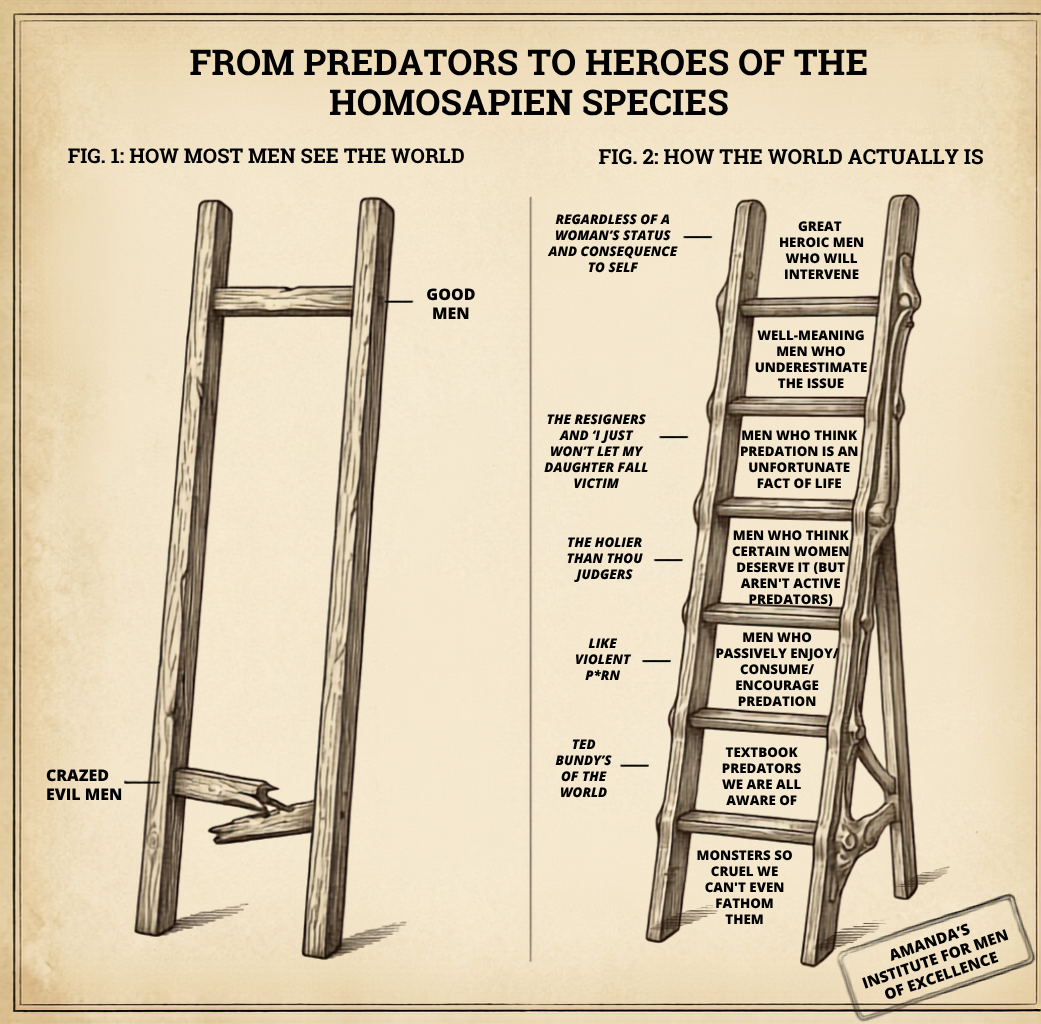
It is a long white bar. Across almost its entire length, this vast comfortable expanse, stand the Good Men. And at the far right edge, a thin red sliver. That sliver holds the Crazed Evil Men. The monsters. The ones on the news. The Ted Bundys of the world.
Two boxes of a single bar spectrum. A big one and a tiny one. And every man reading this has already, automatically, without a flicker of doubt, filed himself into the big one. Of course he has. He never assaulted anyone. He is not the man in the alley, the man on the news, the fanged and distant creature in the little red box. Therefore he is good. Case closed, verdict delivered, court adjourned.
Gentlemen, I understand the appeal. It is the most flattering document a man will ever hold, because it costs him nothing. It demands no examination, no discomfort, no inventory of his own behavior, because it drew the border of "bad" so far from ordinary life that no ordinary man could stand anywhere near it.
It is the geographic version of the sentence I warned about at the end of the last essay in this series, ‘I'm one of the good ones,’ the exact phrase that stops a man from finding out where he actually stands. (And I promise you, if you don't know where you stand, you will never fulfill your potential for greatness.)
But the two-box spectrum carries a fatal flaw. It has no room for the men who actually matter. It erased the enormous middle completely. And the middle, as it turns out, does nearly all the damage.
V. THE REAL LADDER
Allow me to show you the real one. Not two boxes of a single bar spectrum. A gradient, running light to dark, and every man alive stands somewhere on it. I will walk you down it, rung by rung, of a ladder, and I will ask you to do the bravest thing a man can do with a piece of writing, which is to keep honestly asking, the whole way down, "where am I, actually."
And notice how they draw it. Flat. A bar lying on its side, left to right, as though a man's position on it stated a simple fact about him, fixed as his height. Something to observe. Something to file.
Turn it on its end.
Now it is not a chart. Now it is a thing with height. It has a top you cannot see from where you stand and a bottom you would rather not look at, and rungs, actual rungs, the kind that take a man's weight, the kind you have to reach for. A spectrum is something you are. A ladder is something you are on. And the whole distance between those two sentences is the distance between a man who is stuck and a man who is merely low.
A ladder. And nobody stands on a ladder who cannot climb it.
At the very top, the lightest end, stand the heroic men who intervene. The rarest men alive. He sees it forming across the bar, he reads the situation before it finishes becoming a situation, and he steps into it, at real cost to himself. Regardless of consequence or ridicule. Regardless of whether he got burned doing it the last time. He walks over. Twenty feet of sticky floor, every eye in the room swinging toward him, his own friends going quiet at his back, and he walks over anyway.
This man deserves a proper name, because our language for him runs too thin. Call him a Man of Excellence. A steward of whatever room he stands in. An example other men can follow, because he went first. A man who makes the world safer for women in general, not merely for the handful whose safety he already decided belongs to him. That last distinction is the entire thing. Protecting your own is instinct, and every decent animal on this planet manages it. Protecting a stranger, in a moment that offers you nothing, is excellence.
Just below him stand the well-meaning men who underestimate the problem. Good hearts. Bad math. They believe this sort of thing stays rare, a freak event, something that happens to other people in other places, so they do not watch for it, and a man who does not watch cannot step in.
They do not believe the actions of bad men touch everyone. They forgot, or nobody ever told them, that evil runs almost entirely on the silence of good men. Not my woman. Not my responsibility. Not my dishes, not my sink. And in that one comfortable shrug a man hands away his power, his ownership, his say in what the world around him looks like, and then calls the handing-away neutrality.
Below them stand the men who call predation an unfortunate fact of life. The resigned. That's just how some guys are. They made their peace with it quietly, filed it under weather, under things that simply happen, the way rain simply happens, so that a man carries an umbrella his whole life and never once thinks to ask who is doing the raining. And a man who made peace with a thing granted it permission to continue, without ever raising his hand.
Below them stand the men who think certain women had it coming. Here blindness curdles into judgment. "She was dressed like that. She was drunk. She went upstairs with him, what did she think was going to happen?" They assault nobody. But they built the courtroom that acquits the man who does.
Below them stand the men who passively enjoy it, consume it, encourage it. The audience. The laughers. The ones who share the video, who cheer from a safe and deniable distance, who say "come on, it's just a joke" and call you humorless for not laughing. They touch nobody. They simply guarantee the man who does has an audience.
Below them, the textbook predators. The deliberate ones. The men we all, finally, recognize. The reason almost all women and fathers choose the bear.
And at the very bottom, in that thin red sliver, the monsters so cruel we cannot fathom them. The tiny box. The only box where most men let the word "bad" even touch.
Having read that description, where do you think the harm actually lives?
Men believe only the bottom two rungs hold bad men, and everyone above stands safely, comfortably good. But run your eyes back up the ladder. The resigned man who says nothing. The judge who blames her clothes. The audience that laughs. The well-meaning man who never watched.
The vast machinery of harm in this world does not run on monsters. Monsters are rare. It runs on the ordinary men in the middle, every one of whom would swear on his mother's life he belongs to the good ones. The monster lights the match. The men in the middle are the oxygen, and fire has never burned without air.
Watch a fire sometime, really watch it, and you will notice the flame is the least of it. The flame is small and brief and almost beside the point. What a fire needs, what it cannot live one second without, is the enormous invisible room of air around it, doing nothing, taking no side, simply remaining available. Nobody blames the air. Nobody puts the air on trial. And the whole house burns down anyway.
This is what those rooms full of aspiring pickup artists taught me, from the inside, over years. They held no monsters. They held the middle. Men on rungs two, three, four, who did not understand, and whose not-understanding was itself the danger. And every ounce of comprehension I gave them moved them, one careful step, back up toward the light.
But comprehension alone carried them only so far. It moved them into the middle and set them down there, because the middle was as high as anyone in that building knew how to point.
VI. SILENCE IS A RUNG ON THE LADDER
Here is the part the two-box spectrum exists to let a man avoid:
On a ladder, standing still is a position.
The comfortable man in the middle believes that because he would never do the harm, he bears no relationship to it. That his inaction amounts to neutrality, a clean and blameless zero. Politely, this is an illusion. No neutral rung exists on this ladder. Watching is a choice. Silence is a location. The man who sees it, dislikes it, and says nothing did not remove himself from the ladder. He took his seat on it, and that seat has a number.
A famous line covers this, and almost everyone gets its author wrong. The only thing necessary for the triumph of evil is that good men do nothing. Ten thousand coffee mugs and motivational posters credit Edmund Burke. Burke, as far as any honest scholar can tell, never wrote it.1
The real source is the philosopher John Stuart Mill, in an address he gave at the University of St. Andrews in 1867, and his actual words cut sharper than the mug version, because they name the mechanism directly: Bad men need nothing more to compass their ends, than that good men should look on and do nothing.1
Bad men need nothing more. Read it again. Post it to your refrigerator door. The predator does not need the crowd's help. He needs only its silence. He needs the good men to look on, to witness and do nothing. The audience is not incidental to the performance. The audience is the condition that makes the performance possible.
Think about what a theater actually is. Not the stage. The stage is a few boards and some light. A theater is the four hundred people sitting in the dark, facing the same direction, agreeing by their stillness to let whatever happens up there happen. Take them away and the actor is a man talking to himself in an empty building. Nobody has to applaud. Nobody has to cheer. They only have to stay in their seats.
Apply that to the ladder. The resigned man on rung three who finds it all so regrettable and says not one word does not stand beside the harm. He holds it up.
Remove him, remove the whole silent middle, and the predator loses his cover, his laugh track, and his permission at once. Now everyone sees the monster for what he always was, a rare and hunchbacked aberration, standing alone in a room where no one will look away and no one will laugh.
And I know what a certain man does right now, because I have watched men do it in real time, in real rooms. As he reads this, he reaches for the escape hatch. "But I would never do that."
Sir, I believe you. That is not the question. The question is not whether you would do the harm. My question is whether you do anything at all. And on this ladder, doing nothing is doing something. It does not condemn your soul. It describes your location. And you change a location, unlike a soul, by deciding to stand somewhere else.
The data underneath this is not gentle. The fanged stranger in the alley does not commit the large majority of sexual assaults. A friend commits it. A date. A partner. A coworker. A familiar and trusted face.2 The exact percentage shifts with how you define the terms, but every serious dataset tells the same story, and it contradicts the story the two-box spectrum tells. The danger is almost never the distant monster. It is the ordinary man in the room, the one who looked, to everyone including himself, entirely good.
A well-studied reason explains why the middle stays frozen. Psychologists call it the bystander effect, which Darley and Latané first demonstrated in 1968, and its engine carries the name diffusion of responsibility.3
The finding is brutal in its simplicity: the more people who witness an emergency, the less likely any single one of them acts, because each person quietly assumes someone else will.
Responsibility, it turns out, behaves like water. Pour it into one man and he holds it, heavy and undeniable, sloshing against the sides of him until he has to do something with it. Pour the same amount across a room of forty and it spreads so thin across the floor that no one even gets his feet wet.
Responsibility, spread across a crowd, thins to nothing. This is the physics of "someone should really say something" dissolving, every time, into no one does. It is why a man can corner a woman in a crowded bar and the very density of the crowd dooms her.
But, and this is the hinge the whole essay turns on, here… is the hope hiding inside the horror. Silence is not fate. More recent work watched real conflicts unfold on real street cameras and found that in the large majority of them, someone does step in.3 The bystander effect is a tendency, not a sentence. It is a rung, and a man can climb off a rung. Which is what the rest of this essay is about.
VII. HOW TO CLIMB FROM WHERE YOU ARE
As I have stated many a time in my other essays, a diagnosis with no cure is anxiety in a lab coat. Here is the ladder again, and this time, for each rung, the one move that takes you up. Find yourself honestly. Then climb.
If you are a predator or a monster, the bottom two rungs, you already know it, and no essay by a woman on the internet will reach you. So I will spend no more words on you. Everyone else, stay with me.
If you passively enjoy it, share it, laugh at it, the move up is to go quiet in the one place your noise fueled. Stop laughing. Stop sharing. Stop being the crowd. Stop being a lead-sheep. The performance needs an audience or it has no point, and the single most powerful thing you can do from this rung is withdraw the applause. Be the reason he does not bother.
If you think certain women had it coming, the move up is comprehension, the exact thing I spent my twenties teaching. She was drunk. She was dressed like that. She went upstairs. Learn, actually learn, what those sentences describe. They describe a woman who did not consent. Not a woman who did. Judgment, on this rung, is a comprehension failure dressed in the robes of a moral position. Take the robe off. Learn the body language. See the line.
If you find it regrettable but inevitable, the move up is to stop making peace with it. To stop being a disempowered man. That's just how some guys are is a sentence that protects men who do not believe they can change the world. Trade your resignation for a single objection, spoken once, out loud, in a room where it costs you something. Because you are powerful. You matter. You can change the world.
If you underestimate the problem, the move up is to believe the data. Learn how common this actually is. Learn to read a room the way every woman in it already reads it, exhaustingly, the way you would read a room if someone had taught you since girlhood that the wrong man in it could end you. Most men do not learn this until they have daughters, but you do not have to wait. Let that knowledge turn you into a man who notices in time, because noticing in time is the whole ballgame.
And if you already intervene, if you already stand on the top rung, the move is not to rest there admiring the view. It is to make the climb easier for the man one rung below you. Say the thing first, out loud, so the next man finds the courage to say the second thing. This is what almost no one understands about the men at the top: their real work is not the single heroic intervention. It is lowering the cost of courage for everyone standing behind them. A man who speaks first gives permission to a hundred men who only needed to not go first.
That is the work of a Man of Excellence, and it is the only rung on the ladder with no ceiling above it. You do not arrive there and stop. You keep making the next man's climb cheaper than yours.
Now… the hope I promised, and it is not a feeling, it is a finding. When researchers actually studied this, when they took ordinary people and trained them to break the silence and step in, it worked.
The largest and longest trial of bystander-intervention training ever run in schools measured it directly and found that teaching people to interrupt measurably reduced sexual violence, harassment, and stalking.5 Silence is not a permanent feature of the male character, but a feature of the disempowered male. It is a habit, not a fate. And you break a habit on purpose.
The single instruction under every rung is the same. The move up this ladder, from wherever you stand, is always the same two-part move: comprehend more, and stay silent less. Understanding is the engine. Silence is the brake. Take your foot off the brake.
VIII. THE ANSWER I OWED HIM
I never answered his question.
"Are you here to teach us?"
That night I said no and meant it as a simple fact. I was a smart mid-twenties, Hollywood-hot-girl-era woman in black stockings waiting on a French friend who was, as ever, late.
But my honest answer runs harder than that, and it took me years to earn it.
I could not have taught him. Not then. Because I stood on the same sawn-off ladder he did, one rung higher, teaching its top step as though it were the summit. I taught men to read a woman's comfort and I called that the work. I believed it.
Every test I handed them pointed at their own hands, and not once did I think to ask what a man should do when he sees a woman's hand go slack in someone else's. Nobody had asked me either.
He came looking for someone who could show him further up.
And the woman he found had not yet fully comprehended all of the things a man could be.
I think about that sometimes. The two of us in that lobby, the student and the teacher, both standing on the same three rungs and both mistaking the emptiness above for some enigmatic sky. He asked me for the way up and I could not give it to him, not because I withheld it, but because I did not yet know how to explain the beyond.
So here is the answer, years late, to a man whose name I never learned.
Yes. Now. And not the thing you paid for. Something better. The rest of the ladder.
And now you hold it too, which brings me to the uncomfortable part.
I already know what you have done this whole essay, because every man does it. You have quietly, steadily decided that you stand further up the ladder than the men I described. That certainty, that comfortable little glow of well, this isn't really about me, is the two-box spectrum talking. It is the mirage. It is the anesthetic.
I am not asking you to hate yourself or call yourself a mediocre man. I am asking you to look down and count.
And now let me make good on the promise I made you in the first paragraph.
That man in the lobby, the one you spent this entire essay quietly feeling superior to, stands closer to greatness than most of the men reading this.
Not because he had better instincts. Because he did the one thing almost no man does.
He admitted a deficiency. Out loud, to himself, in a way that cost him money and time and pride. He looked at his own life, found something missing, and went hunting for the answer. He crossed all those time zones to sit in a folding chair and take notes on how to talk to a woman, which required him first to say the sentence most men will not say under torture: I do not know how to do this.
That is self-awareness, and it arrived with effort attached. Those two things together are the entire fuel of the climb.
Now picture the man on rung three who has never questioned himself once. He finds it all regrettable and says nothing. He has never paid a dollar or an ounce of pride to become better at anything involving another human being. He holds the higher position and carries none of the fuel. He stands still, and he stands comfortable, and comfort is the most expensive thing a man ever buys, because he pays for it with every version of himself he might have become.
The pickup artist stood on a low rung, climbing.
Most men stand on a higher rung, parked.
I would bet on the climber every time.
The good news?
Locating yourself lower than you hoped delivers no sentence. It marks a starting line. And every single rung has a way up.
Most men will finish this essay, feel a flicker of something, and file it away. A few of you will not. A few of you will walk into a room this week and call out some bullsh*t even when it costs you something, and one man standing nearby will watch you do it and understand, maybe for the first time in his life, that the ladder keeps going.
That is how this spreads. Not through essays. Through men, true leaders, who climb one rung in public.
You are not a good man because you stand at a safe distance from the monster.
You are a good man on the day you turn to the man beside you, the one everyone in the room carefully pretends not to see, and you say the thing out loud.
And you become a great one on the day you stop asking what is good for you, right now, and start asking: ‘What are you here on this plant to steward? What do you value as a man? What are your principles? What is worth fighting for, dying for? Do you stand up for injustice? Do you protect those who cannot protect themselves? Beyond your family, what will your legacy be? Do you desire Greatness and are you willing to do the work that it requires of you?’
With love, always,
— Amanda
P.S. This is the second essay in a series on what makes a good man, a bad man, and a great man. Gentlemen, going together beats going alone. Keeping the company of great men feels more normal when you stand up together. If a man comes to mind while you read this, you know what to do. Send it to him. As a vote of confidence, because you already know he is the kind who would want to find the ladder.
Sources & Citations
1. The maxim "the only thing necessary for the triumph of evil is that good men do nothing" is almost universally attributed to Edmund Burke, but there is no evidence Burke ever wrote or said it; researchers who have traced it (including the editors of respected quotation dictionaries) find no source in his works. The closest genuine antecedent is John Stuart Mill, Inaugural Address Delivered to the University of St. Andrews (February 1, 1867): "Bad men need nothing more to compass their ends, than that good men should look on and do nothing."
2. Rape, Abuse & Incest National Network (RAINN), summarizing U.S. Department of Justice, Bureau of Justice Statistics, National Crime Victimization Survey: in approximately 8 out of 10 cases the perpetrator is someone known to the victim. The precise share of "known" perpetrators varies across studies (estimates range from roughly 47% to over 80%) depending on how "rape" and "known" are defined, the population sampled, and whether data come from victimization surveys or administrative records; across methods, the consistent finding is that most sexual violence is committed by someone the victim knows, not a stranger.
3. Darley, J.M. & Latané, B. (1968). Bystander intervention in emergencies: Diffusion of responsibility. Journal of Personality and Social Psychology, 8(4), 377-383. doi:10.1037/h0025589. The foundational demonstration that the presence of additional witnesses reduces the likelihood that any individual intervenes. Note that the effect has been refined by later work: a 2019-2020 analysis of real-world CCTV-recorded public conflicts found that at least one bystander intervened in the large majority (roughly 90%) of cases, indicating that the bystander effect is a real but conditional tendency rather than an ironclad law.
4. Kruger, J. & Dunning, D. (1999). Unskilled and unaware of it: How difficulties in recognizing one's own incompetence lead to inflated self-assessments. Journal of Personality and Social Psychology, 77(6), 1121-1134. doi:10.1037/0022-3514.77.6.1121. Across four studies, participants scoring in the bottom quartile on tests of humor, grammar, and logic dramatically overestimated their performance, in part because the metacognitive skill required to recognize incompetence is the same skill whose absence produces the incompetence. The paper's epigraph quotes Garrison Keillor's Lake Wobegon.
5. Coker, A.L., Bush, H.M., Cook-Craig, P.G., DeGue, S.A., Clear, E.R., Brancato, C.J., Fisher, B.S., & Recktenwald, E.A. (2017). RCT Testing Bystander Effectiveness to Reduce Violence. American Journal of Preventive Medicine, 52(5), 566-578. The largest and longest randomized controlled trial of a bystander-intervention program (Green Dot) in high schools; implementation was associated with significant reductions in sexual violence perpetration and related interpersonal violence. See also Coker et al. (2011), Evaluation of Green Dot, Violence Against Women, 17(6), 777-796.